
The Winter Hexagon
The Winter Hexagon: The Giant Pattern Hidden in the Winter Sky
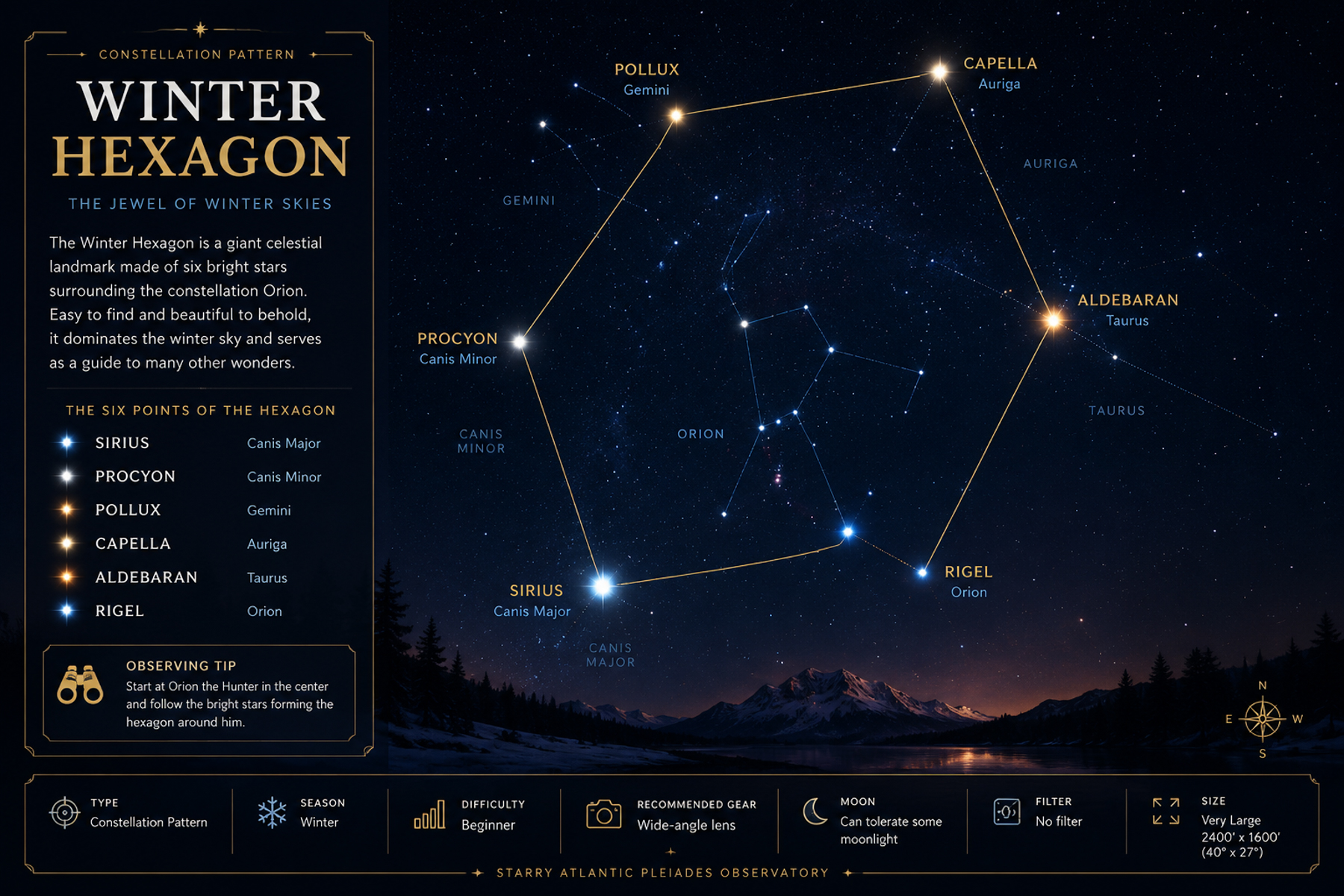
When most people think about winter astronomy, they immediately picture Orion the Hunter. While Orion is certainly one of the most recognizable constellations in the night sky, it is also the centerpiece of something much larger and often overlooked: the Winter Hexagon. The Winter Hexagon is a massive celestial pattern formed by six of the brightest stars visible from Earth. Unlike a constellation, which is officially recognized by astronomers, the Winter Hexagon is known as an asterism—a recognizable pattern created by stars that belong to different constellations. Together, these stars create a giant six-sided shape that dominates the winter sky.
The Six Stars of the Winter Hexagon
The Winter Hexagon is formed by:
- Sirius — Canis Major
- Procyon — Canis Minor
- Pollux — Gemini
- Capella — Auriga
- Aldebaran — Taurus
- Rigel — Orion
At the center of this enormous pattern sits Orion, making the Winter Hexagon surprisingly easy to locate once you know where to look.
Why It Is Worth Finding
The Winter Hexagon contains some of the brightest and most famous stars in the night sky. Sirius, often called the Dog Star, is the brightest star visible from Earth. Aldebaran marks the eye of Taurus the Bull, while Capella shines as one of the brightest stars in the northern sky. Because the pattern spans a large portion of the sky, it is best appreciated with the naked eye rather than a telescope.
How to Find the Winter Hexagon
Begin by locating Orion. Once Orion is visible, identify Rigel, the bright blue-white star marking Orion's foot. From there, trace the surrounding bright stars: Rigel → Aldebaran → Capella → Pollux → Procyon → Sirius → back to Rigel. The result is a giant hexagon surrounding Orion.
Best Time to Observe
The Winter Hexagon is best viewed from late autumn through early spring. During December, January, and February, it reaches its highest point in the evening sky, making it one of the easiest large-scale star patterns to observe.
Observing Tips
- No telescope is required.
- Binoculars can enhance nearby star fields and clusters.
- A dark sky location will reveal even more surrounding stars.
- The pattern can still be seen under moderate moonlight.
Because of its immense size, a wide-angle view of the sky is often more rewarding than high magnification.
A Hidden Jewel of Winter
Many observers spend years identifying Orion without realizing that they are standing beneath one of the largest and most beautiful patterns in the sky. The Winter Hexagon serves as a gateway to many of winter's greatest celestial treasures and offers a wonderful way to become familiar with the seasonal night sky. The next clear winter evening, step outside and look beyond Orion. You may discover that the real giant of the season has been hiding in plain sight all along.
Clear skies,
Itxier Meziani
Starry Atlantic Pleiades
Winter Hexagon illustration created for Starry Atlantic Pleiades.
Questions & Discussion
Have you ever noticed the Winter Hexagon in the winter sky?